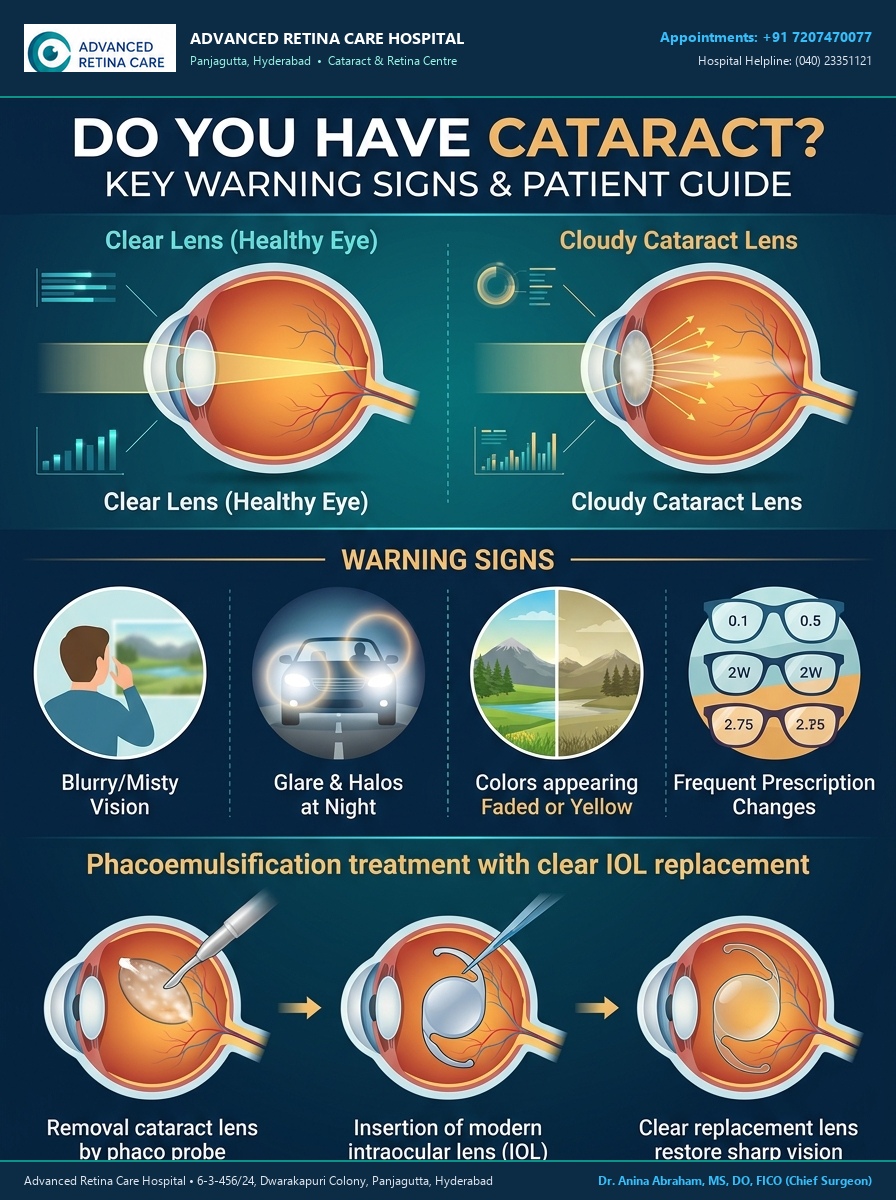
Cataract is one of the most common causes of reduced vision with increasing age. It develops when the natural lens of the eye becomes cloudy, causing vision to gradually become less clear.
If you are experiencing blurred vision, glare while driving at night, difficulty seeing clearly, or a gradual deterioration in your eyesight, you may be wondering: How do I know if I have cataract?
The good news is that cataract can usually be diagnosed during a comprehensive eye examination, and modern cataract surgery can restore the clarity of vision when the cataract begins to interfere with everyday activities.
If you are looking for cataract surgery near me, a cataract doctor near me, or a cataract surgeon near me, it is important to choose an eye-care centre where your eyes can be thoroughly evaluated and the most appropriate treatment and lens option can be discussed with you.
Complete Cataract Patient Guide Index
1. What is Cataract and What Causes It?
A cataract is a clouding of the natural lens inside the eye. The natural lens is positioned behind the pupil and is normally crystal clear, helping focus light cleanly onto the retina at the back of the eye.
As the natural lens becomes cloudy, light cannot pass through it cleanly, resulting in gradually reduced, hazy, or distorted vision.
What Causes Cataract?
Ageing is the primary and most common factor associated with cataract formation. Over time, natural proteins inside the crystalline lens break down and clump together, gradually creating opacity.
Cataracts can also develop or progress more rapidly due to other factors such as diabetes mellitus, prolonged steroid medication usage, previous eye injuries or trauma, high myopia (severe nearsightedness), or previous eye surgery. The exact cause and rate of progression can vary significantly from person to person.
2. Cataract Symptoms & Early Warning Signs
Cataract does not always produce noticeable symptoms in its earliest stages. As the clouding progresses, however, patients typically notice:
Vision feels hazy or like looking through a frosted window pane.
Halos, dazzling starbursts, and glare from oncoming car headlights.
Spectacle numbers changing frequently without yielding crisp focus.
Colors appear washed out or tinted with a yellowish/brownish hue.
Ghosting or multiple overlapping images seen in one eye.
Difficulty recognizing faces across a room or reading small print.
Early Cataract Symptoms
Early cataract symptoms can be subtle. You may feel that your glasses are no longer giving you the same clarity, that colors appear less bright, or that night driving has become increasingly uncomfortable due to glare.
If you notice a gradual change in your vision, don't simply assume that it is an unavoidable part of ageing. A proper eye examination can confirm whether cataract is developing.
3. How Do I Know If I Have Cataract?
The only reliable way to determine whether you have a cataract is to have your eyes examined by an ophthalmologist using a slit-lamp biomicroscope.
During an examination, your vision, intraocular pressure, and ocular structures are assessed. The ophthalmologist evaluates whether cataract is present, measures its density, and ensures that other eye conditions—such as macular degeneration, diabetic retinopathy, or glaucoma—are not contributing to your visual difficulties.
If cataract is diagnosed, your doctor will discuss whether observation is appropriate or whether cataract surgery should be considered based on your lifestyle needs.
4. What Are the Cataract Stages?
Cataracts progress gradually over months or years. In the early stages, the lens clouding may have little impact on your daily routine. With time, the clouding becomes denser, firmer, and more extensive, progressively impairing vision.
Important Clinical Concept: The decision to perform cataract surgery is not based solely on the visual appearance or "stage" of the cataract. The true determining factor is the effect of the cataract on your functional vision, safety, and daily quality of life.
5. Can Cataract Be Cured Without Surgery?
Patients often ask: "Can cataract be cured without surgery? Can eye drops or ayurvedic medicines dissolve my cataract?"
Definitive Medical Fact
Once a cataract has formed, there is currently no scientifically validated eye drop, tablet, herbal medication, eye exercise, or dietary supplement that can dissolve or clear the cloudy natural lens. When a cataract significantly interferes with your vision and daily activities, surgical removal of the cloudy lens and replacement with a clear intraocular lens (IOL) is the only established and effective cure.
6. When Should Cataract Surgery Be Done?
Not every cataract requires immediate surgery. If your vision is still adequate for your routine tasks, your ophthalmologist may recommend periodic monitoring. Surgery becomes appropriate when the cataract begins to interfere with your ability to perform daily activities comfortably and safely, including:
- Reading books, newspapers, or mobile screens
- Driving safely, especially during dusk or nighttime
- Watching television or using computers
- Performing your professional work or hobbies
- Recognizing the faces of friends and family across a room
- Moving around safely without fear of tripping or falling
There is no single visual-acuity number that dictates surgery for everyone. Your ophthalmologist will evaluate your eyes and help you decide whether the benefits of surgery justify the procedure in your personal circumstances.
7. Is Cataract Surgery Safe and Painful?
Is Cataract Surgery Safe?
Modern cataract surgery (Phacoemulsification) is one of the most commonly performed, refined, and successful surgical procedures in all of modern medicine. It boasts an exceptionally high safety profile. However, like any surgical procedure, it carries potential risks and complications.
Your individual risk profile depends on the health of your eye, the density of the cataract, and systemic factors like diabetes. A detailed pre-operative clinical evaluation helps identify and minimize any potential risk factors.
Is Cataract Surgery Painful?
Cataract surgery is generally performed using topical anaesthetic eye drops to numb the eye surface completely, without painful injections behind the eye. Most patients experience no pain during the surgery, reporting only sensations of light, water, and mild pressure. Mild irritation, scratchiness, or watering may occur for a short time afterwards, which is easily managed with prescribed eye drops.
How Long Does Cataract Surgery Take?
The actual surgical procedure typically takes only 10 to 15 minutes in uncomplicated cases. However, your total stay at the eye hospital will be about 2 to 3 hours to allow for pupil dilation, pre-operative preparation, and brief post-operative monitoring.
8. Which Intraocular Lens (IOL) Is Best for You?
One of the most important decisions you will make before cataract surgery is choosing the appropriate Intraocular Lens (IOL). The IOL is the permanent artificial lens implanted inside the eye to replace your cloudy natural lens.
Patients frequently ask: "What is the best lens for cataract? Which is the most expensive or premium lens?"
There is no single "best" lens for every patient. The best IOL is not automatically the most expensive one. The appropriate lens must be carefully customized to your corneal anatomy, retinal health, visual expectations, occupational needs, and lifestyle.
Types of Intraocular Lenses (IOLs) Explained:
- Monofocal Lenses: Designed to provide sharp focus at one primary distance (usually distance vision). You will wear simple reading glasses for computer or close reading work. Monofocal lenses offer the highest contrast sensitivity and are the safest option for patients with retinal conditions, diabetic retinopathy, or glaucoma.
- Toric Lenses: Specifically designed to correct corneal astigmatism (cylindrical error) alongside cataract removal, ensuring crisp distance vision without astigmatic blur.
- Multifocal & Trifocal Lenses: Engineered with multiple optical zones to provide vision across distance, intermediate (computer/dashboard), and near (mobile/reading) ranges, substantially reducing dependence on spectacles. Requires a healthy cornea and pristine retina.
- Extended Depth of Focus (EDOF) Lenses: Provide a continuous blend of distance and intermediate vision with minimal night glare or halos.
At Advanced Retina Care, Dr. Anina Abraham conducts high-precision optical biometry calculations and evaluates your retina thoroughly to recommend the safest and most suitable IOL for your visual future.
9. Cataract Surgery in Hyderabad & Cost Factors
If you are searching for cataract surgery Hyderabad, cataract operation Hyderabad, or the best cataract surgeon Hyderabad, it is vital to choose a hospital where your eyes receive a comprehensive evaluation—including detailed retinal screening—before surgery is scheduled.
At Advanced Retina Care Hospital, Panjagutta, Hyderabad, cataract surgery is performed with advanced micro-incision phacoemulsification systems in ultra-sterile modular operating suites.
Cataract Surgery Cost & Price Factors
Cataract operation costs can vary depending on several clinical factors:
- The type of IOL selected: Standard monofocal, imported hydrophobic monofocal, toric astigmatic, or premium trifocal/EDOF lenses.
- Diagnostic investigations required: Optical biometry (IOL Master), corneal topography, and macular OCT scans.
- Surgical complexity: Dense cataracts, small pupils, loose zonules, or combined cataract-retina procedures.
We offer transparent package pricing, cashless health insurance processing, and comprehensive pre-operative counseling to help you make the best choice within your budget.
10. What Happens During Cataract Surgery?
During modern phacoemulsification surgery:
- Your eye is thoroughly numbed with anaesthetic eye drops.
- A microscopic, self-sealing incision (2.0 to 2.8 mm) is made at the edge of the clear cornea.
- An ultrasonic probe gently breaks up (emulsifies) the cloudy natural lens and removes the fragments with gentle suction.
- The artificial intraocular lens (IOL) is folded and gently inserted into the natural lens capsule where it unfolds into its permanent position.
- The micro-incision seals naturally without stitches or sutures.
11. Cataract Surgery Recovery Time, Precautions & Aftercare
Cataract surgery recovery is generally smooth and rapid. Many patients notice improved clarity within 24 to 48 hours, although the eye continues to heal and stabilize over the following 3 to 4 weeks.
Essential Post-Operative Precautions:
- Instill prescribed eye drops: Use antibiotic and anti-inflammatory eye drops strictly on schedule as directed by your surgeon.
- Protect your eye: Wear protective sunglasses outdoors and wear the protective eye shield while sleeping during the first week.
- Keep water away: Avoid splashing tap water or soap directly into the operated eye for 7 to 10 days.
- Avoid rubbing: Never rub, press, or touch the operated eye.
- Avoid heavy exertion: Refrain from heavy weightlifting, swimming, or vigorous contact sports for 3 to 4 weeks.
When to Contact Your Surgeon Immediately
While complications are rare, seek prompt medical attention if you experience:
- Significant or increasing eye pain that is not relieved by prescribed medications
- Progressive redness or swelling of the eye
- A sudden drop or deterioration in vision after initial improvement
- Seeing flashes of light, new dark floaters, or a dark shadow in your vision
12. When Should You See a Cataract Surgeon?
If your vision is becoming progressively blurry, you experience glare while driving at night, or changing your glasses fails to restore clear vision, it is time to have a comprehensive cataract evaluation.
Whether you need surgery immediately, in a few months, or simply continued monitoring can only be determined after a meticulous clinical assessment.
Book Your Comprehensive Cataract Evaluation
Don't let cloudy vision compromise your safety and independence. Consult Senior Surgeon Dr. Anina Abraham at Advanced Retina Care Hospital, Panjagutta, Hyderabad for precision cataract care and custom lens selection.
Call Helpline: +91 7207470077
Dr. Anina Abraham, MS, FRCS
Senior Eye Surgeon & Vitreoretinal Specialist
Alumnus of L V Prasad Eye Institute (LVPEI)
With over 20 years of clinical experience, Dr. Anina Abraham specializes in advanced phacoemulsification cataract surgery, complex retina-cataract cases, and diabetic eye care.