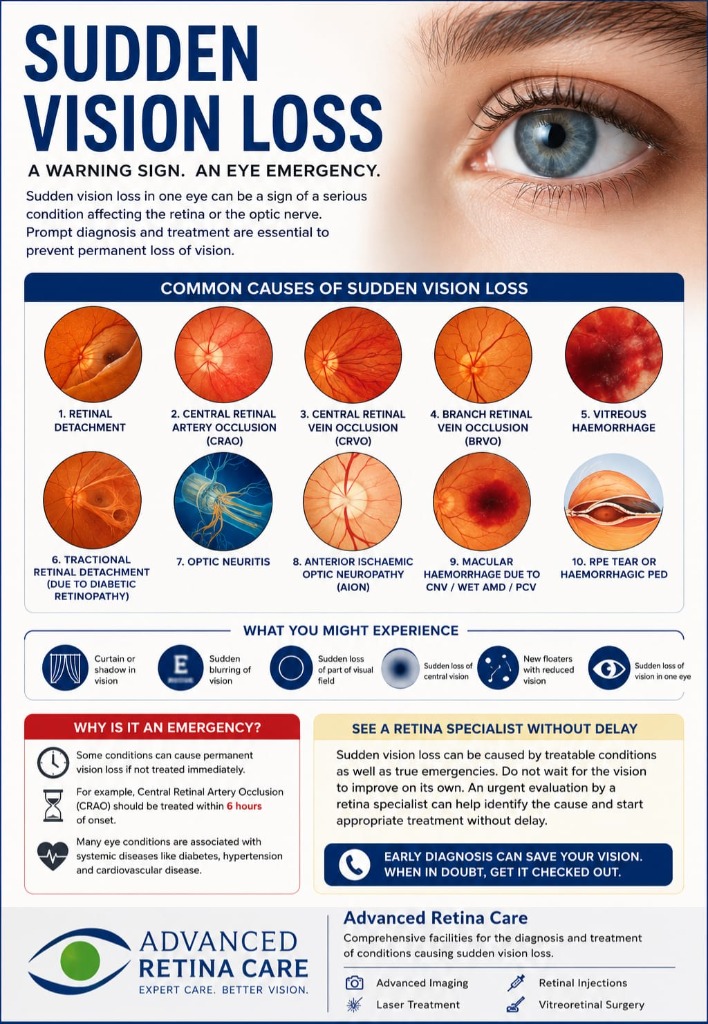
Sudden vision loss in one eye is a medical emergency. Whether it presents as a sudden total blackout, a dark curtain descending across your vision, or a severe blurring of central detail, immediate evaluation by a fellowship-trained Vitreoretinal Specialist is vital to prevent irreversible blindness.
In many cases, sudden visual loss is completely painless. Because there is no pain or redness, patients occasionally make the dangerous mistake of waiting a few days to see if their vision recovers on its own. Delaying treatment can lead to permanent photoreceptor loss.
9 Common Causes of Sudden Painless Vision Loss
Senior retina surgeon Dr. Anina Abraham outlines the primary conditions responsible for sudden visual decline:
1. Retinal Detachment
Occurs when subretinal fluid passes through a retinal break, lifting the neurosensory retina away from the underlying retinal pigment epithelium. Patients often describe a dark shadow or curtain coming across their visual field. Without prompt vitreoretinal surgery (vitrectomy or scleral buckling), the detachment will spread across the entire retina, causing complete vision loss.
2. Vitreous Haemorrhage in Diabetic Retinopathy
In patients with diabetes, fragile new blood vessels (proliferative diabetic retinopathy / PDR) can rupture and bleed into the vitreous gel. This results in an abrupt, painless clouding of vision, often described as seeing dark red swirls, webs, or complete fog. Treatment involves anti-VEGF injections, retinal laser, or emergency vitrectomy surgery.
3. Tractional Retinal Detachment
A severe complication of advanced diabetic eye disease where fibrovascular scar tissue contracts and physically pulls the retina away from the back of the eye. When the macula is pulled, sudden severe vision loss occurs, requiring delicate microsurgery.
4. Retinal Vein Occlusions (CRVO / BRVO)
A thrombosis (blood clot) blocking the central retinal vein (CRVO) or a branch vein (BRVO) causes severe back-pressure, diffuse retinal hemorrhages, and marked macular swelling (edema). Patients experience sudden or rapid blurring. Treatment involves anti-VEGF intravitreal injections and retinal laser therapy.
5. Central Retinal Artery Occlusion (CRAO - Acute Eye Stroke)
A blockage of the central retinal artery that completely cuts off oxygenated blood to the inner retina. This causes profound, sudden, painless blindness in the affected eye within seconds. CRAO is a true ophthalmic emergency—retinal tissue can suffer irreversible damage within hours. Urgent evaluation is required to save vision and assess systemic cardiovascular stroke risks.
6. Optic Neuritis
Inflammation of the optic nerve, frequently occurring in younger adults. It causes rapid reduction in vision, impaired color perception (colors appear dull), and mild to moderate pain or discomfort with eye movement.
7. Anterior Ischaemic Optic Neuropathy (AION)
Inadequate blood flow to the head of the optic nerve, more common in older individuals with hypertension, diabetes, or sleep apnea. It typically manifests as sudden loss of the upper or lower half of the visual field (an altitudinal defect). Urgent evaluation is critical to safeguard the fellow eye.
8. Sudden Macular Haemorrhage (CNV / Wet AMD / PCV)
Bleeding beneath the macula from Choroidal Neovascularisation (CNV) in Wet AMD or Polypoidal Choroidal Vasculopathy (PCV). Peripheral vision remains intact, but central reading and facial recognition vision suddenly darkens or distorts. Prompt anti-VEGF injections are indicated.
9. RPE Tear & Haemorrhagic Pigment Epithelial Detachment
A sudden tear in the retinal pigment epithelium beneath the macula, causing immediate drop in central visual acuity. Early evaluation helps stabilize underlying disease.
Emergency Retina Care at Advanced Retina Care, Panjagutta
Advanced Retina Care provides comprehensive round-the-clock diagnostic and therapeutic facilities for all causes of sudden vision loss:
- Emergency Dilated Fundus & Retinal Periphery Evaluation
- High-Definition OCT for immediate macular fluid mapping
- Same-Day Intravitreal Injections & Green Laser Photocoagulation
- Advanced Sutureless Micro-Incision Vitrectomy Surgery (MIVS)

Dr. Anina Abraham, MS, FRCS
Senior Eye Surgeon & Vitreoretinal Specialist
Alumnus of L V Prasad Eye Institute (LVPEI)
A trusted vitreoretinal surgeon with over 20 years of clinical experience managing retinal detachments, ocular strokes, vitreous hemorrhage, and retinal vascular occlusions in Hyderabad.