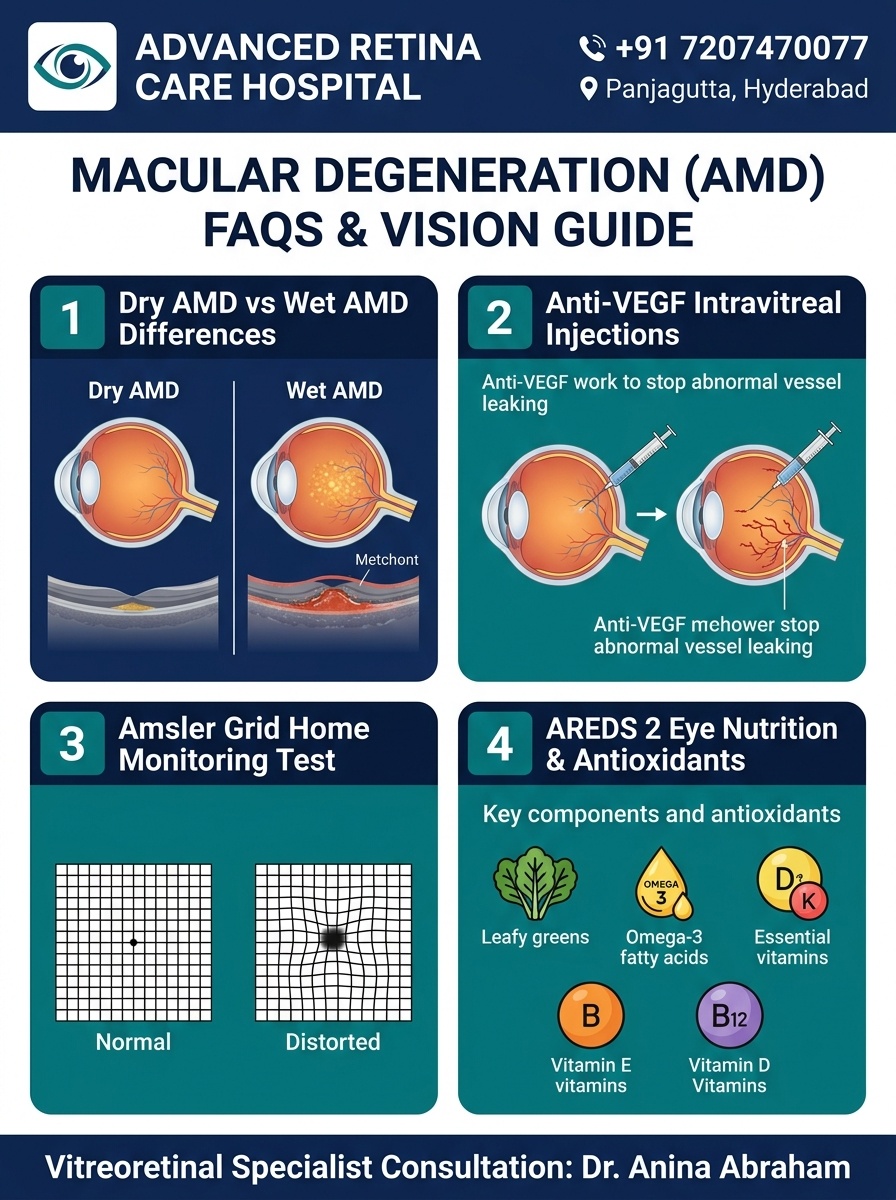
Age-Related Macular Degeneration (AMD) is one of the leading causes of central visual impairment in individuals over the age of 50. If you or a loved one has been diagnosed with dry or wet AMD, you likely have important questions regarding injections, vision recovery, diet, and monitoring.
Below, Senior Vitreoretinal Specialist Dr. Anina Abraham answers the most frequently asked questions based on clinical evidence and daily practice at Advanced Retina Care, Hyderabad.
Can macular degeneration be treated and controlled?
Macular degeneration is a chronic condition that is effectively controlled and managed with ongoing care. In Wet AMD, modern anti-VEGF injections halt active leakage, resolve macular edema, and significantly improve or stabilize vision. In Dry AMD, antioxidant therapy and regular monitoring protect remaining retinal cells and prevent rapid progression.
Can lost vision come back after treatment?
Yes, in many patients with Wet AMD, prompt treatment with anti-VEGF injections restores substantial visual acuity by clearing fluid and bleeding beneath the macula. However, vision may not return to 100% if permanent scarring (fibrosis) or geographic atrophy has already developed. The key to maximizing visual recovery is beginning injections as early as possible after symptoms appear.
What is the difference between Dry AMD and Wet AMD?
Dry AMD (Non-neovascular): Accounts for about 85–90% of cases. It progresses slowly over years as cellular metabolic waste deposits called drusen accumulate under the retina, causing gradual thinning of the macula.
Wet AMD (Neovascular / Exudative): Accounts for only 10–15% of cases but causes the vast majority of severe, rapid vision loss. It occurs when abnormal, fragile new blood vessels (Choroidal Neovascularization or CNV) sprout beneath the retina and leak blood, lipid, and serous fluid into the macula.
Why are eye injections needed for wet macular degeneration?
A protein called Vascular Endothelial Growth Factor (VEGF) triggers the growth of fragile, leaky blood vessels in wet AMD. Anti-VEGF medications injected directly into the vitreous cavity bind to this protein, stopping vessel proliferation, drying up retinal leakage, and preventing further retinal damage.
Are anti-VEGF eye injections painful or dangerous?
Intravitreal injections are safe, outpatient procedures performed under local anesthetic numbing drops in a sterile theater. Most patients report feeling only mild pressure lasting 1 to 2 seconds, without sharp pain. Complications such as infection (endophthalmitis) or retinal detachment are exceptionally rare when performed by an experienced retina specialist adhering to strict aseptic protocols.
How many injections will I need?
Treatment typically starts with a "loading phase" of 3 monthly injections. Following this, your retina specialist will tailor the frequency using a Treat-and-Extend or PRN (as needed) regimen based on monthly OCT scans. Newer extended-acting formulations may extend intervals up to 12 to 16 weeks between treatments.
Can eye drops or oral tablets replace eye injections?
No. Currently, there are no proven eye drops or pills capable of penetrating to the retina in sufficient concentration to stop abnormal blood vessel growth in wet AMD. Intravitreal injections remain the global standard of care.
Which vitamins or diet help slow dry macular degeneration?
The landmark National Eye Institute AREDS 2 (Age-Related Eye Disease Study 2) proved that a specific formulation of antioxidant vitamins and minerals can reduce the risk of intermediate dry AMD progressing to advanced wet AMD by approximately 25%. The formula includes:
- Lutein (10 mg) & Zeaxanthin (2 mg)
- Vitamin C (500 mg) & Vitamin E (400 IU)
- Zinc Oxide (80 mg) & Copper (2 mg)
Eating leafy green vegetables (spinach, kale), colorful bell peppers, and omega-3 rich fish is also highly beneficial.
How often do I need an OCT scan?
High-resolution Optical Coherence Tomography (OCT) is the gold standard for tracking macular health. For patients actively receiving anti-VEGF injections, an OCT scan is performed before each injection (every 4 to 8 weeks). For stable dry AMD, an OCT examination every 6 to 12 months is generally advised.
How can I monitor my vision at home using an Amsler Grid?
An Amsler Grid is a simple square grid with a black dot in the center. While wearing reading glasses, cover one eye and look directly at the central dot from 12 to 14 inches away. Check if all grid lines appear straight and parallel. If lines look wavy, bent, broken, or if dark patches appear, contact your retina specialist immediately.
Is macular degeneration hereditary?
Yes, genetics play a significant role. If a parent, sibling, or child has AMD, your risk of developing the condition is approximately 3 to 4 times higher. Regular annual retina evaluations after age 50 are strongly recommended for individuals with a family history.
Is macular degeneration an emergency?
Dry AMD is a slowly progressing condition and not an acute emergency. However, Wet AMD can present suddenly—if you notice rapid vision drop, new distortion of straight lines, or a dark shadow in your central vision, this indicates active bleeding and must be assessed by a retina specialist within 24 to 48 hours.
Should I see a general eye doctor or a retina specialist?
Because macular degeneration specifically affects the delicate neural retina and choroidal vascular beds, evaluation and management by a fellowship-trained Vitreoretinal Specialist is essential. Specialized diagnostics (OCT, OCT Angiography, FFA) and expert intravitreal injection delivery ensure the best visual outcomes.

Dr. Anina Abraham, MS, FRCS
Senior Vitreoretinal Specialist & Founder, Advanced Retina Care
Alumnus of L V Prasad Eye Institute
Specializing in cutting-edge anti-VEGF injection therapies, retinal laser treatments, and micro-incision vitreoretinal surgery for macular disorders.