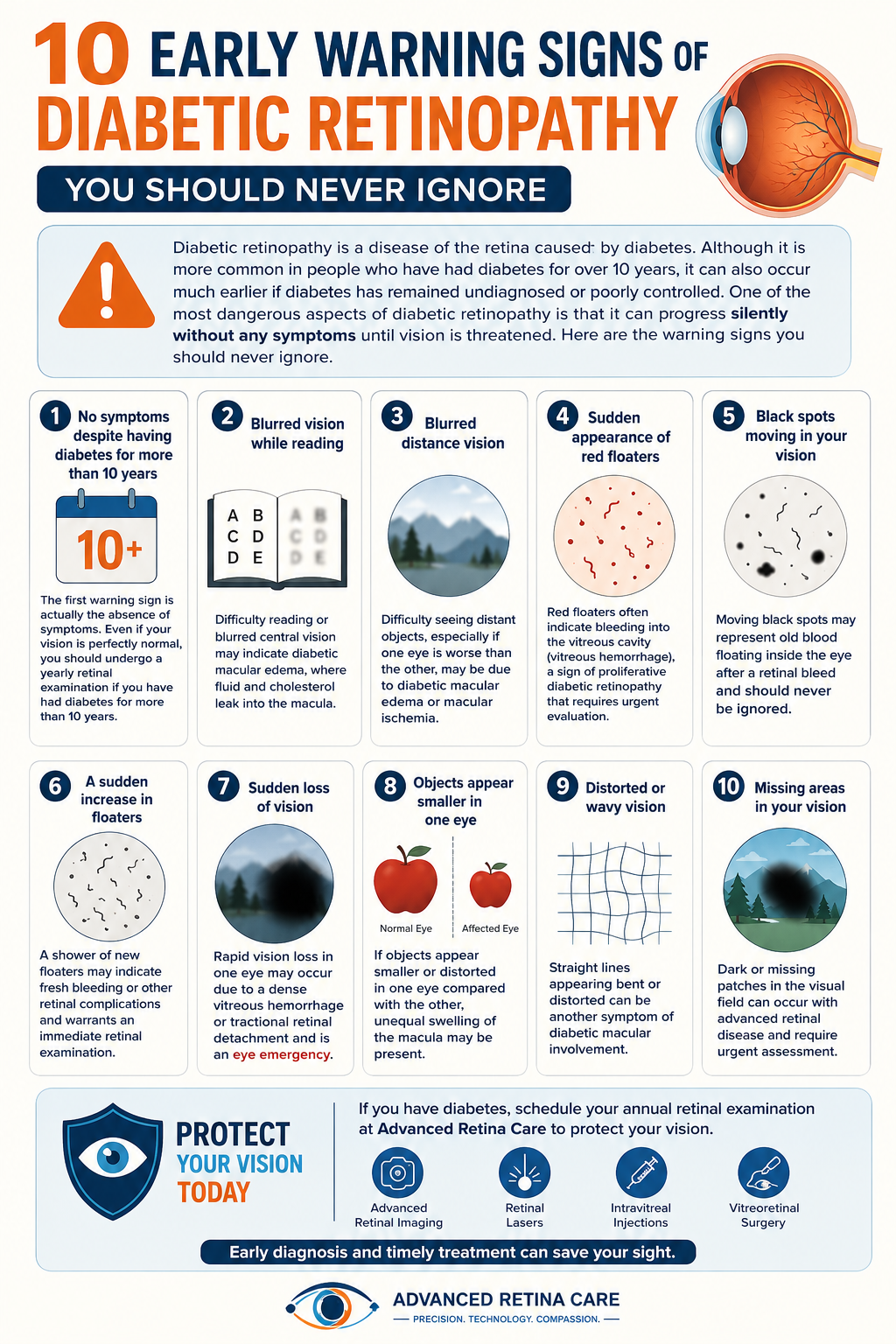
Diabetic retinopathy is a progressive retinal disease caused by diabetes. Although more common in patients with diabetes for over 10 years, it can occur earlier if blood sugar has been poorly controlled. Because it can progress silently, recognizing early warning signs is vital to saving your sight.
- 1. No Symptoms Despite 10+ Years of Diabetes
- 2. Blurred Vision While Reading
- 3. Blurred Distance Vision
- 4. Sudden Appearance of Red Floaters
- 5. Black Spots Moving in Your Field of Vision
- 6. A Sudden Shower of New Floaters
- 7. Sudden Loss of Vision
- 8. Objects Appear Smaller in One Eye (Micropsia)
- 9. Distorted or Wavy Vision (Metamorphopsia)
- 10. Dark or Missing Patches in Vision
1. No Symptoms Despite 10+ Years of Diabetes
The single most dangerous warning sign is having no symptoms at all. Even with perfect 20/20 vision, retinal blood vessel damage may already be progressing quietly behind your eye. Learn why this happens in our guide on diabetic retinopathy as a silent threat.
2. Blurred Vision While Reading
Difficulty reading small print or fine details may be an early indicator of diabetic macular edema (DME), where fluid leaks into the central part of the retina (the macula).
3. Blurred Distance Vision
Blurriness when looking at distant objects, especially if one eye feels worse than the other, can stem from macular swelling or retinal ischemia.
4. Sudden Appearance of Red Floaters
Seeing reddish streaks, cobwebs, or reddish floaters often signifies bleeding into the vitreous cavity (vitreous hemorrhage) from fragile new blood vessels in proliferative diabetic retinopathy (PDR).
5. Black Spots Moving in Your Field of Vision
Dark, moving spots in your field of vision can be old blood clusters inside the eye and require an immediate retinal evaluation.
6. A Sudden Shower of New Floaters
A sudden increase or shower of floating spots indicates fresh retinal bleeding or traction on retinal tissue.
7. Sudden Loss of Vision
Rapid, painless vision loss in one eye is a medical emergency often caused by dense vitreous hemorrhage or tractional retinal detachment. Seek emergency care immediately.
8. Objects Appear Smaller in One Eye (Micropsia)
If objects look distorted or smaller in one eye compared to the other, unequal macular swelling may be altering retinal geometry.
9. Distorted or Wavy Vision (Metamorphopsia)
Straight lines—like door frames, window blinds, or grid lines—appearing bent or wavy is a classical sign of macular fluid accumulation.
10. Dark or Missing Patches in Vision
Empty spots or shadow-like curtains in your peripheral or central field indicate severe retinal involvement requiring urgent care. Read our treatment guide on lasers, injections, and surgery.