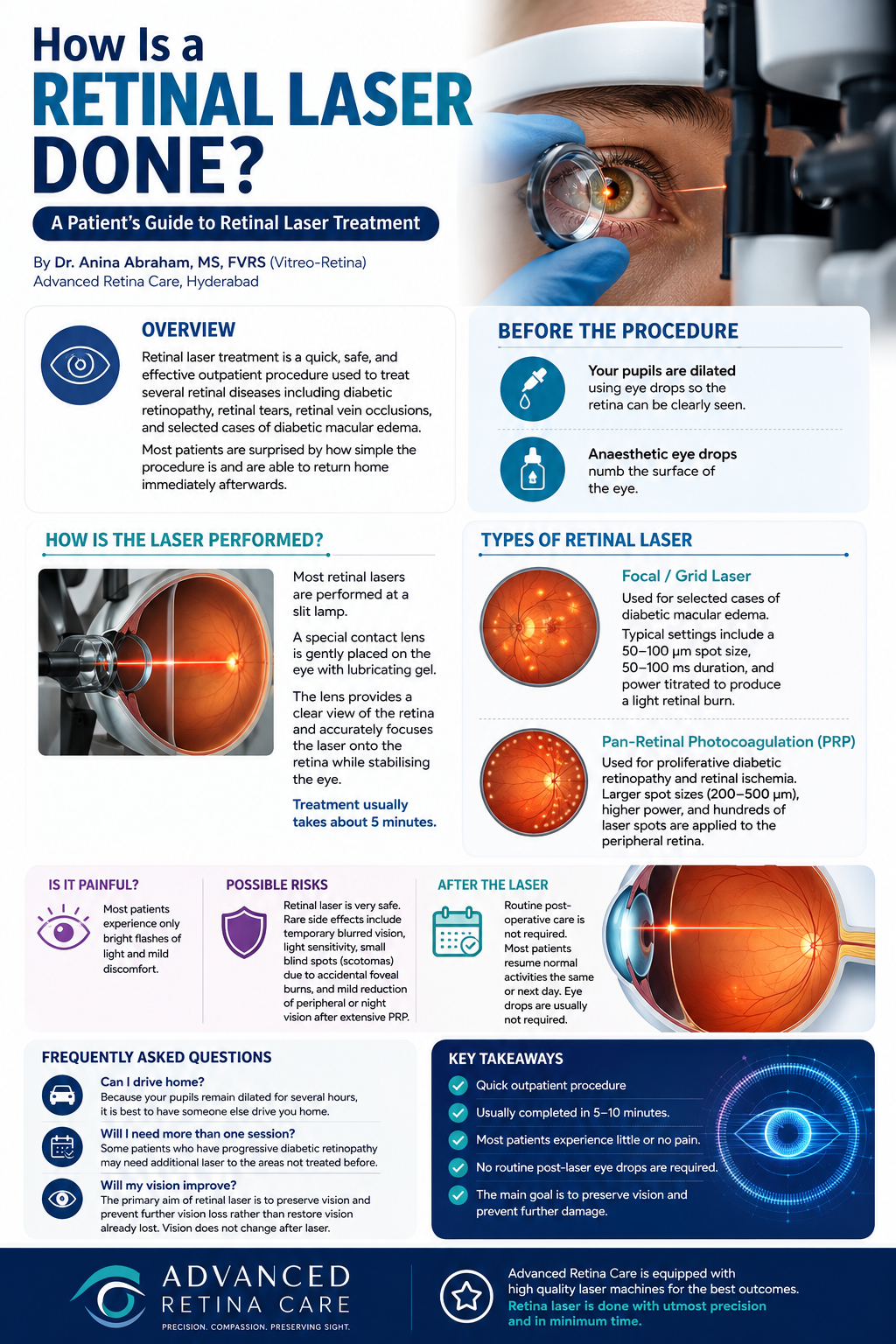
Retinal laser treatment (photocoagulation) is a quick, safe, and effective outpatient procedure used to treat diabetic retinopathy, retinal tears, and vein occlusions. Written by Dr. Anina Abraham, MS, FVRS, this guide explains what to expect before, during, and after your retinal laser procedure.
Overview of Retinal Laser Procedure
Retinal laser treatment (photocoagulation) is performed right in the clinic room without surgical incisions or hospital stays. Most patients are pleasantly surprised by how simple, quick, and painless the procedure is and are able to return home immediately afterwards. Learn more about treatment options for diabetic retinopathy.
Before the Procedure (Dilation & Numbing)
Eye drops are administered to fully dilate your pupils, giving the doctor a clear view of the retina. Anesthetic eye drops are applied to numb the surface of your eye so you remain comfortable throughout. Read our guide to retina examinations.
How Is the Laser Performed?
You sit comfortably at a specialized slit-lamp microscope. Dr. Anina Abraham places a special contact lens gently onto your eye with lubricating gel. This lens stabilizes eye movement and focuses laser light precisely onto the target areas of your retina. The procedure takes only 5 to 10 minutes.
Types of Retinal Laser (Focal vs PRP)
- Focal / Grid Laser: Applied to micro-spots on the macula to treat localized diabetic macular edema (DME).
- Pan-Retinal Photocoagulation (PRP): Applied to oxygen-deprived peripheral areas of the retina to halt abnormal blood vessel growth in proliferative diabetic retinopathy (PDR).
Is It Painful?
Most patients feel only bright flashes of light and occasional mild tingling sensations. The anesthetic drops keep the surface of the eye completely numb.
Frequently Asked Questions (FAQs)
Can I drive home after laser?
Because your pupils will remain dilated and sensitive to light for several hours, we recommend having a family member or friend drive you home.
Will I need more than one session?
PRP laser is sometimes completed in 1 to 2 short sessions depending on the extent of peripheral retinal involvement.
Will my vision improve immediately?
The main goal of retinal laser is to preserve your current vision and prevent future vision loss, rather than altering refractive power. Read our article busting myths about retinal lasers.