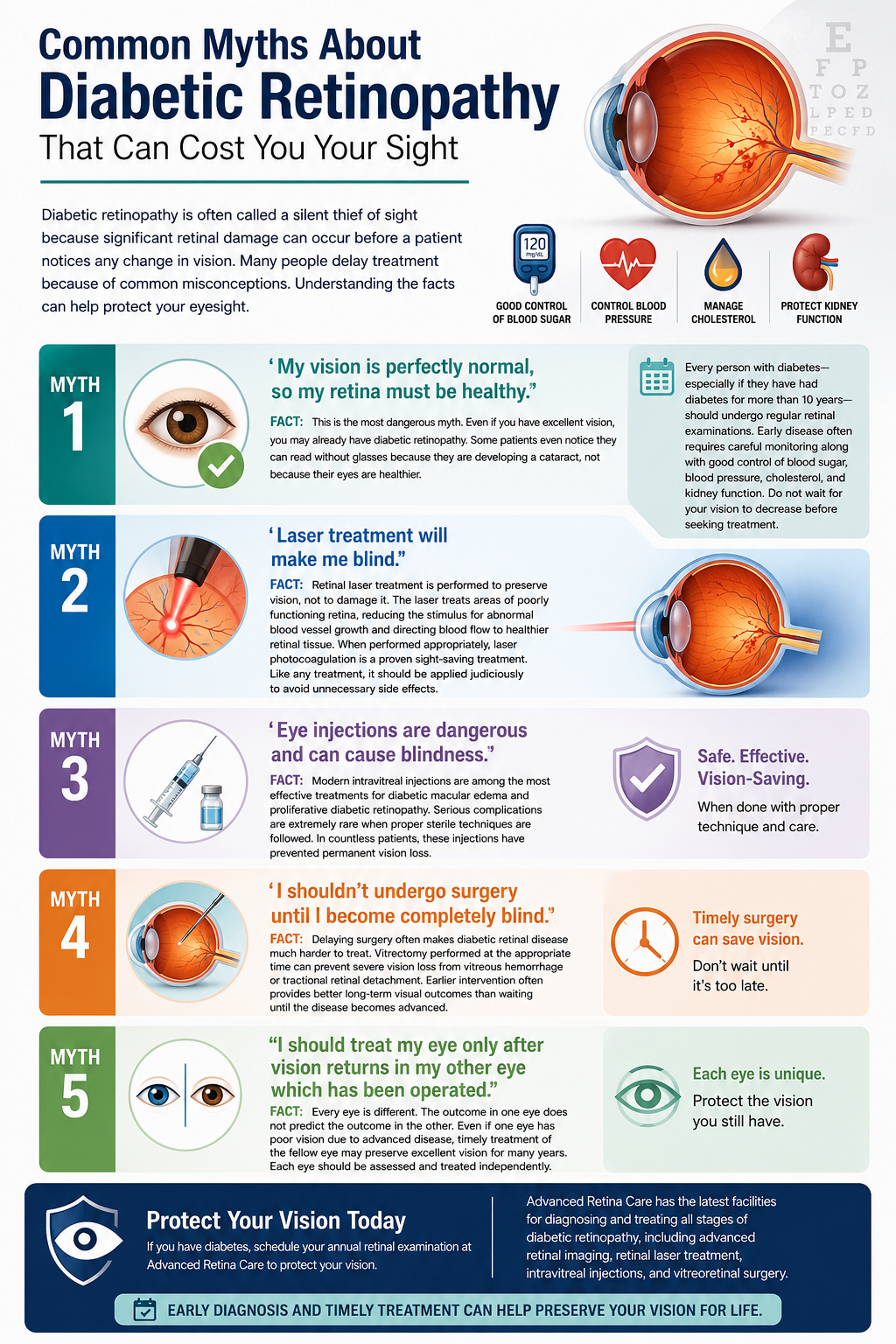
Diabetic retinopathy is often called a 'silent thief of sight' because severe retinal damage can take place long before vision drops. Unfortunately, dangerous misconceptions prevent many patients from seeking timely care. Let's examine 5 common myths and the medical facts behind them.
- Myth 1: 'My vision is 20/20, so my retina must be healthy.'
- Myth 2: 'Retinal laser treatment will make me blind.'
- Myth 3: 'Eye injections are dangerous and cause blindness.'
- Myth 4: 'I shouldn't undergo surgery until I am blind.'
- Myth 5: 'I should wait for vision to return in one eye before treating the other.'
Myth 1: 'My vision is 20/20, so my retina must be healthy.'
Fact: This is the single most dangerous myth. Diabetic retinopathy can progress through mild, moderate, and severe NPDR stages without causing any visual impairment. Waiting for vision to drop before seeing a doctor often means catching the disease at an advanced stage. Learn about 10 early warning signs you shouldn't ignore.
Myth 2: 'Retinal laser treatment will make me blind.'
Fact: Retinal laser treatment (PRP) is a proven sight-saving procedure performed to prevent blindness. The laser treats non-functioning peripheral retina, reducing oxygen demand and stopping abnormal vessel growth that leads to severe bleeding. Read our guide on how a retinal laser is done step-by-step.
Myth 3: 'Eye injections are dangerous and cause blindness.'
Fact: Modern intravitreal Anti-VEGF injections are among the safest and most effective medical treatments in ophthalmology. When administered under sterile clinical protocols, complication rates are extremely low, and millions of patients worldwide have had their vision saved by injections. Explore our treatment guide on lasers, injections, and surgery.
Myth 4: 'I shouldn't undergo eye surgery until I am completely blind.'
Fact: Delaying vitrectomy surgery makes treatment much more complex. Performing surgery at the right clinical window yields far superior visual outcomes compared to waiting until scar tissue causes irreversible retinal detachment.
Myth 5: 'I should wait for vision to return in one operated eye before treating the other.'
Fact: Every eye develops diabetic retinopathy independently. The condition in one eye does not dictate the healing or vision potential in the other eye. Timely treatment of each eye preserves sight independently. Schedule your dilated eye exam today.